

Trumouse Product Overview
Trumouse is an automated analysis system for mouse behavior in laboratory environments. It fuses low-frequency RFID identification with machine-vision models to simultaneously identify and track the movements of colony-scale groups of individuals during natural behavior; building on this, it integrates agent-based analysis and experiment workflows that support automated experiment design, result analysis, and reliable chart generation.
The hardware comprises a Reader Array in the floor platform, overhead imaging and lighting subsystems, an external Compute Unit, and the Universal Port — a standardized environment interface arranged on the enclosure wall. All connections between the electronic subsystems are wired; see System Architecture for the Trumouse Pro and System Architecture for the Trumouse Lite.
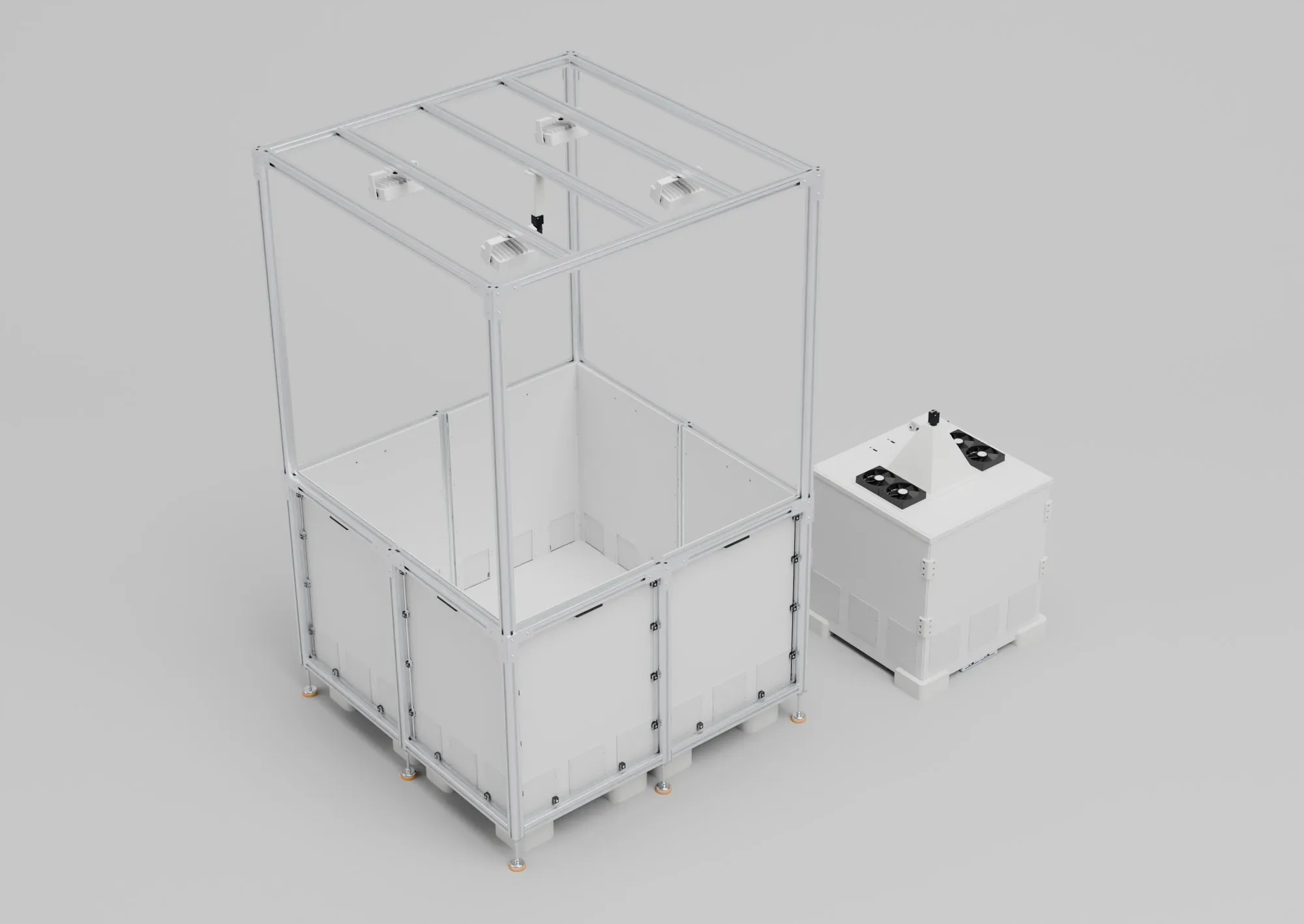
Figure: The Trumouse Pro (left) and Trumouse Lite (right), shown at the same scale
Product Models
Section titled “Product Models”Trumouse is available in two models that share the core component designs and software. They differ mainly in arena size, Reader Array scale and lighting:
Table: Model specification comparison
| Specification | Trumouse Pro | Trumouse Lite |
|---|---|---|
| Activity area | 1200 mm × 1200 mm | 600 mm × 600 mm |
| Overall dimensions (length × width × height) | Approximately 1296 mm × 1296 mm × 2130 mm | Approximately 660 mm × 660 mm × 935 mm |
| Mice tracked (recommended) | 20 | 5 |
| Reader blocks | 2 × 2 (4 blocks total) | 1 block |
| Reading positions | 144 | 36 |
| Reader Array network ports | 8 | 2 |
| Lighting | Infrared Light | White Light, Infrared Light |
| RFID identification | ✓ | ✓ |
| Vision-based movement tracking | ✓ | ✓ |
| Environmental monitoring | ✓ | ✓ |
| Universal Port | ✓ | ✓ |
| Trumouse Console | ✓ | ✓ |
| Agent-based analysis | ✓ | ✓ |
| Automated experiment design | ✓ | ✓ |
| Automated result analysis and chart generation | ✓ | ✓ |
This manual applies to both models. System components, installation, maintenance and troubleshooting, and the model-specific technical specifications (system architecture, power supply and electrical specifications, and external interfaces and ports) are covered in a separate part for each model: the Trumouse Pro part starts at System Components and the Trumouse Lite part at System Components. All other chapters, including the common technical specifications, apply to both models, and any differences are marked with the model name.